If you’re asking yourself, “How can I measure AEO success?”, AEO rank trackers should be your next investment. They gauge your brand visibility in AI-generated answers, considering metrics like citations, mentions, share of voice, and sentiment.
Sifting through the noise is frustrating, though, because AEO (answer engine optimization) and AEO rank trackers are relatively new categories. In this guide, I’ll explain what you need to know to choose the best tool for you, including must-have features, a simple scoring framework, and examples of the best AEO tools available.
What AEO Rank Trackers Measure and How They Differ From SEO
What AEO Rank Trackers Measure and How They Differ From SEO
AEO rank trackers measure whether your brand appears in an AI-generated answer, and if so, how prominently. By contrast, traditional SEO rank trackers measure where your website appears in a list of blue links on the search engine results page.
That distinction matters because AI answer engines don’t return ranked lists of webpages in the way traditional search engines do — they synthesize responses.
How AI Engines Build Answers
When someone asks ChatGPT, Perplexity, or Gemini a question like “what’s the best CRM for small businesses,” the engine doesn’t just pull a top result. It retrieves information from across the web, evaluates source authority and relevance, and composes a single narrative response, often referencing multiple brands, pages, and data points in the process.
Some of those references are citations: explicit links or attributions to a specific source the engine used to build its answer. Others are simple mentions: the engine names your brand without linking back to any of your content. Both signal visibility, but they mean different things. A citation tells you the engine treated your content as a credible source. A mention tells you your brand has enough presence in the broader information ecosystem to surface in the response, even without a direct link.
AEO rank trackers are designed to capture both citations and mentions, and to distinguish between them, something traditional SEO tools were never built to do.
AEO vs. SEO Tracking
Here’s where the metrics diverge most clearly.
SEO tracking centers on keyword rankings, clicks, and impressions — all tied to a specific page’s position in a search results list. AEO tracking measures a different set of signals entirely:
- Brand mentions and citations. How often your brand or content is referenced in AI-generated answers, and whether those references include a link back to your site.
- Answer position. Where your brand appears within the response itself — early in the answer or buried at the end.
- Share of voice. How your brand’s presence compares to competitors across AI-generated answers. If there are 100 brand mentions, and your brand shows up in 30 of them, your share of voice is 30%.
AI-generated answers are structurally different from ranked search results, and measuring them requires different instrumentation. If you’re still relying solely on keyword rankings to understand your search visibility, you’re measuring one channel (SEO) and missing the other (AEO).
What to Look for in AEO Rank Trackers
Not every AEO tracker measures the same things, and the feature gaps between platforms are wider than you might expect. The best answer engine optimization tools with LLM performance tracking combine multi-engine coverage with citation-level analytics. Before you evaluate specific AEO checking tools, it helps to know which capabilities matter most for your workflows.
Must-Have Features
- Multi-engine coverage. At minimum, your tracker should monitor ChatGPT, Gemini, and Perplexity. Some platforms also cover Copilot and Google AI Overviews. If you’re only tracking one engine, you’re getting a partial picture; answer engines don’t all pull from the same sources or weight them the same way.
- Prompt libraries and custom prompt tracking. You need the ability to define and organize the questions your buyers are actually asking. The best trackers let you build prompt groups by product line, use case, or buyer segment so you’re not analyzing everything as a single undifferentiated pile.
- Citation and mention analysis. The metrics I outlined above — citations, mentions, share of voice, answer position — are table stakes. But look for depth here: Can you see which URLs are being cited? Can you compare your citation rate against competitors over time? Surface-level mention counts won’t help you prioritize content next steps. The best tools for monitoring AEO citations in LLMs go beyond counts and show you exactly which URLs are earning those references.
- Brand sentiment tracking. Visibility alone doesn’t tell you the full story. If an answer engine is mentioning your brand but framing it negatively (citing poor reviews, outdated complaints, or unfavorable comparisons), that’s a problem you need to catch early. Look for trackers that score sentiment across responses.
- Dashboards, exports, and alerts. You’ll need to report on this data regularly, so look for clean dashboards you can share with stakeholders, export options for deeper analysis, and alerting that flags meaningful changes — like a competitor suddenly appearing in answers where they weren’t before.
- Integrations. The more connected your AEO data is to your existing stack (CMS, CRM, project management), the easier it is to act on what you find. Disconnected data leads to disconnected workflows.
Mapping Features to Real Use Cases
The features above aren’t abstract checkboxes. Here’s how they translate into practical workflows:
- Content prioritization. Citation analysis and prompt tracking together show you exactly where your content gaps are, such as which prompts mention competitors but not you, and which content types are getting cited most. From there, you can build an editorial calendar based on data instead of guesswork.
- PR triage. Sentiment tracking is where this gets actionable. If answer engines start describing your brand negatively, or a competitor’s earned media placement shifts the narrative against you, that’s your signal to step in with counter-messaging, outreach, or updated content.
- Monitoring workflows. Dashboards and exports turn AEO from a one-time audit into an ongoing practice. Weekly score tracking lets you measure whether content changes are actually moving the needle, which is critical for justifying continued investment. Pairing your AEO tracker with a broader content performance framework ensures you’re connecting AI visibility to real business outcomes.
Pro Tip: When evaluating trackers, don’t just compare feature lists. Run the same set of 5-10 prompts through each tool’s free trial and compare the depth and accuracy of what comes back. The differences will be obvious fast. The HubSpot AEO tool offers a free 28-day trial that lets you track 10 prompts on ChatGPT.
How to Turn AEO Rank Tracker Insights Into Content Wins
Once your tracker is collecting data, the most productive place to start is often by scoping out your competitors — specifically, the ones showing up in AI answers where you aren’t.
Reverse-Engineering Competitor Visibility
Most AEO trackers let you compare citation rates and mention frequency across brands for the same set of prompts. That comparison is where the real editorial strategy lives.
Start by identifying the prompts where a competitor is consistently cited and you’re not. Using competitive analysis tools alongside your AEO tracker can give you deeper context on where rivals are winning. Then look at what’s being cited: the specific URLs, content types, and source categories the engine is pulling from. You’re not just asking, “Are they showing up?” You’re asking, “What did they publish, and where, that earned them that citation?”
The revealing patterns tend to cluster around a few common factors:
- Content format. If 70% of citations for a prompt point to listicles or comparison pages, and your coverage of that topic is a single long-form guide, the format mismatch is likely costing you visibility. Match the format the engine is already rewarding.
- Third-party presence. Competitors often earn citations not from their own site, but from being mentioned on review platforms, industry publications, or community forums like Reddit. If your competitor’s brand appears in a cited Wirecutter roundup and yours doesn’t, that’s a PR and partnerships gap.
- Recency and specificity. Answer engines tend to favor content with current data and precise claims over broad, undated overviews. If a competitor’s 2026 benchmark report is being cited and your most recent version is from 2024, updating that asset should become a top priority.
Turning the Analysis Into an Action Plan
Once you’ve identified the patterns, map each gap to a specific action: Publish a new comparison page, pitch for inclusion in a third-party roundup, refresh an outdated report with current data, or create content in a format the answer engine is favoring for that prompt cluster.
The goal isn’t to copy what competitors are doing. It’s to understand what the answer engine values for each prompt category and create something even better with your own expertise and data.
How to Choose an AEO Rank Tracker for Your Team
Knowing what features matter is one thing. Deciding which tool fits your team depends more on how you work than on which platform has the longest feature list.
Before comparing tools, run through these questions to narrow the field:
- Coverage and scope. Which answer engines do your buyers actually use? If your audience skews toward Gemini but the AEO rank tracker lacks that data, then look elsewhere.
- Workflow alignment. Where does AEO data need to go after your team reviews it? A tracker that integrates with your CMS or CRM eliminates the manual step of exporting CSVs and rebuilding context elsewhere.
- Analytics depth vs. simplicity. Enterprise teams may want granular citation data they can slice across dozens of prompt groups. A lean team of two or three needs a cleaner dashboard with actionable recommendations.
- Governance. Larger organizations should ask about role-based access, prompt change approvals, and audit trails, especially if multiple teams are tracking prompts independently.
- Budget. Pricing models vary: per prompt, per engine, per seat. Map the structure to your actual usage, because a tool that looks cheaper on paper may cost more once you add the coverage you need.
A Simple Scorecard for Comparing Platforms
I’d recommend building a weighted scorecard with five to seven criteria based on the factors above. Rate each tool on a 1-5 scale, weight by priority, and let the math surface the best fit. It removes the bias that creeps in during polished product demos.
Examples of AEO Rank Trackers to Explore
The AEO rank trackers below represent different approaches to monitoring. This isn’t an exhaustive list, and the category is evolving fast. Use the must-have criteria and scorecard from the previous section to evaluate each option against your team’s needs.
1. HubSpot AEO
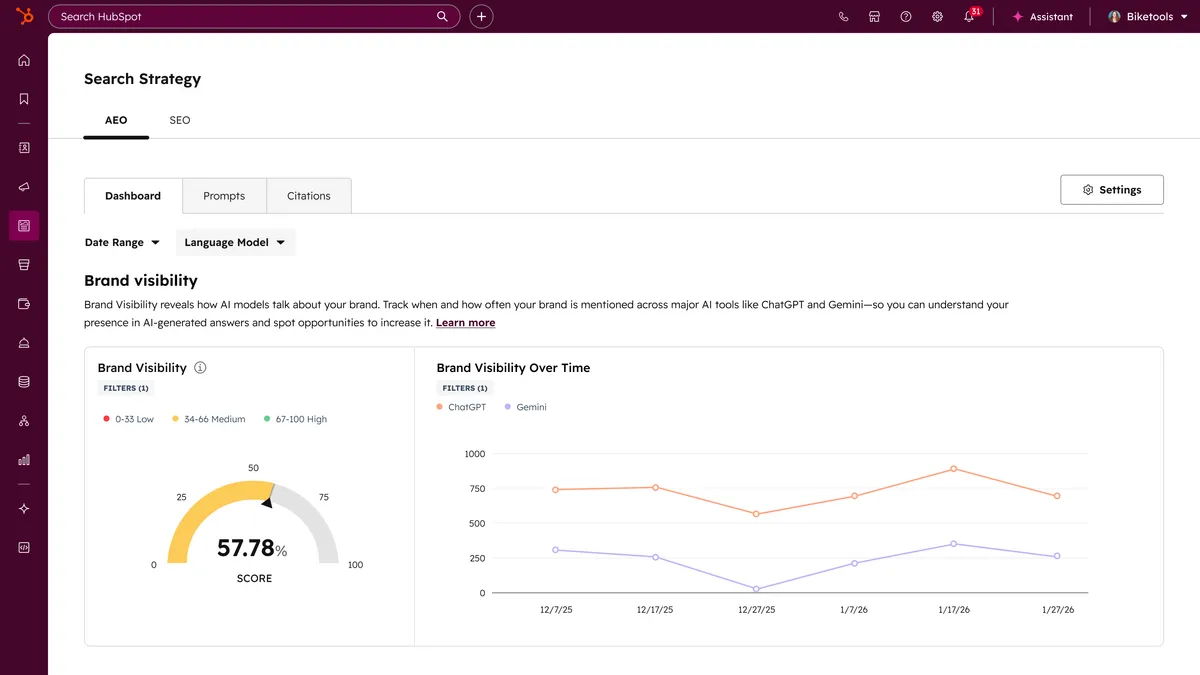
Best for: Teams that want visibility tracking and content execution in the same workflow.
HubSpot AEO tracks brand visibility, citations, share of voice, and sentiment across ChatGPT, Perplexity, and Gemini. You can track up to 25 prompts on the paid plan ($50/month) — the same prompt volume as Marketing Hub Pro. Marketing Hub Enterprise increases that to 50 prompts.
Where it pulls ahead is what happens after you see the data. Citation analysis identifies which domains and content types are influencing AI answers. For Marketing Hub Professional and Enterprise customers, CRM data informs prompt suggestions, so your tracking is tailored to your business rather than starting from generic queries. Get started with a free 28-day trial of HubSpot AEO with 10 prompts on ChatGPT.
2. Semrush AI Visibility Toolkit
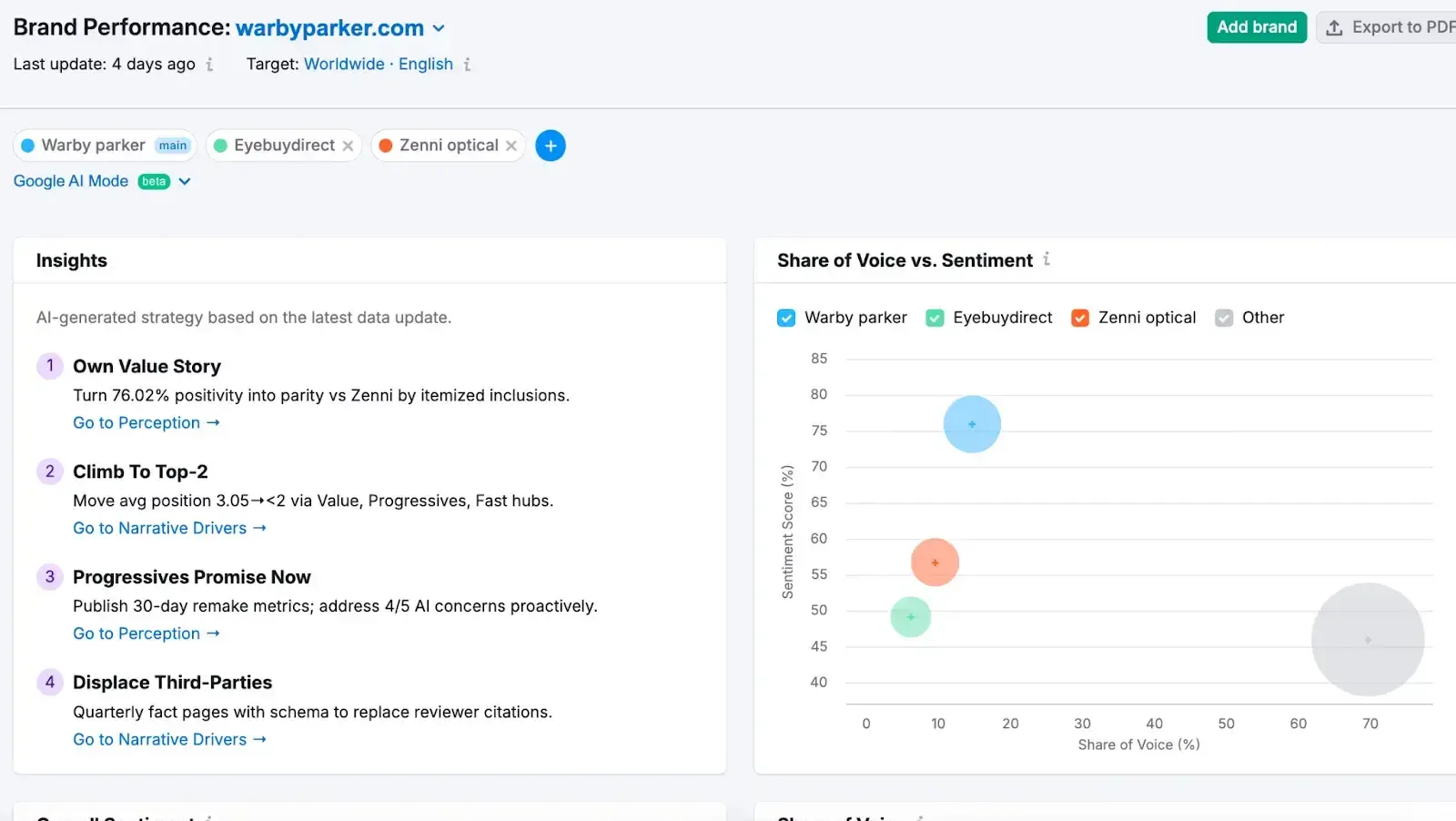
Source
Best for: SEO teams adding AEO to an existing Semrush workflow
Semrush tracks brand mentions and sentiment across ChatGPT, Google AI Mode and AI Overviews, Gemini, and Perplexity. The AI Visibility Toolkit’s Prompt Tracking measures Average Position, showing you where your site usually appears in a list of citations in AI answers for prompts that you’ve defined. The standalone AI Visibility Toolkit is $99/month; Semrush One starts at $199/month. If you already use Semrush, consolidating reduces tool sprawl.
3. Profound
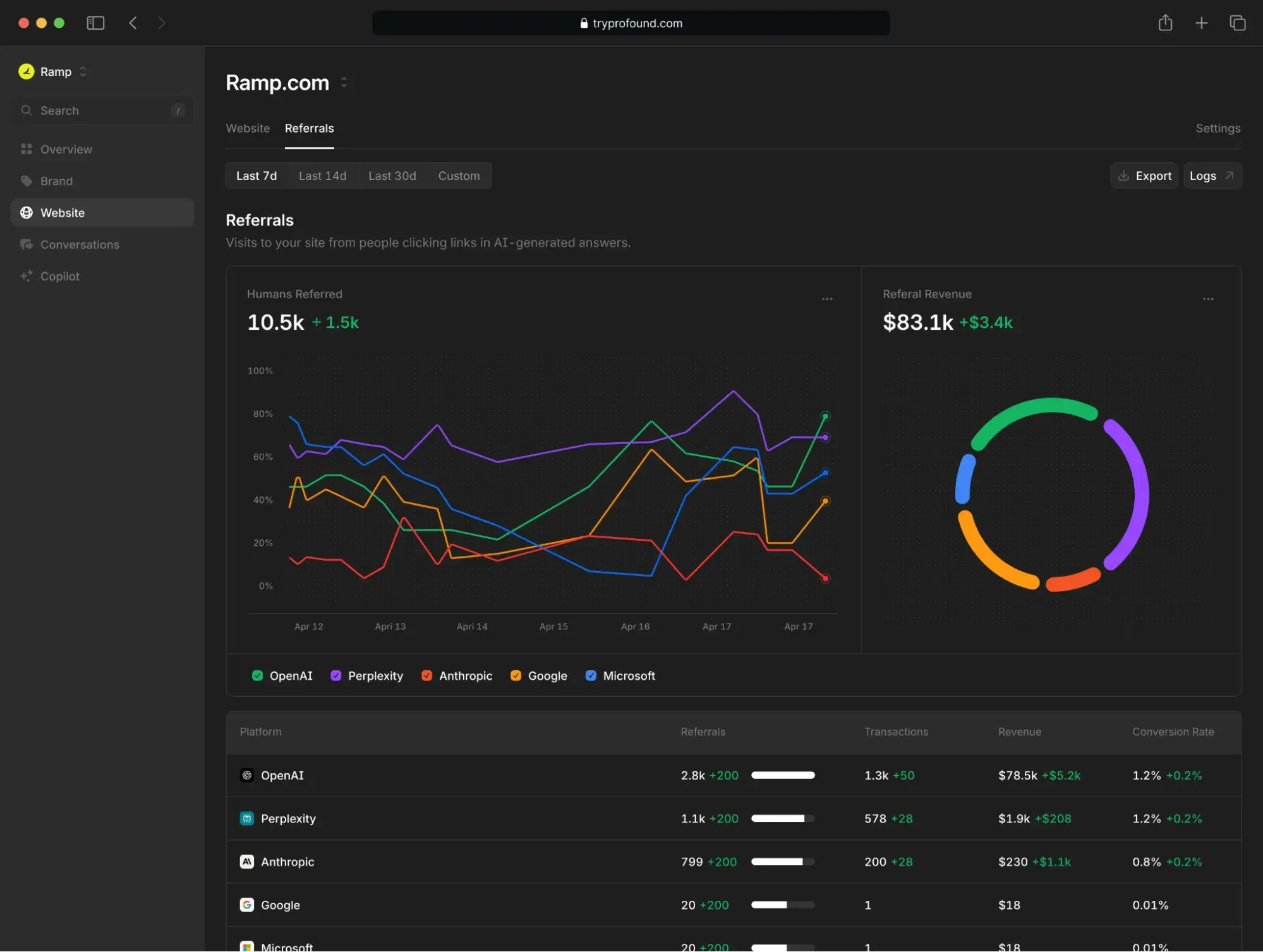
Source
Best for: Enterprise teams that want deep analytics
Profound covers up to 10 answer engines, including ChatGPT, Gemini, Claude, Perplexity, Copilot, Grok, and DeepSeek, with features like query fanout and prompt volumes. Like Semrush’s AI Visibility Toolkit, Profound measures your brand’s Average Position in AI responses. Profound pricing starts at $99/month for ChatGPT-only tracking (50 prompts); multi-engine coverage begins at the $399/month Growth tier.
4. Otterly
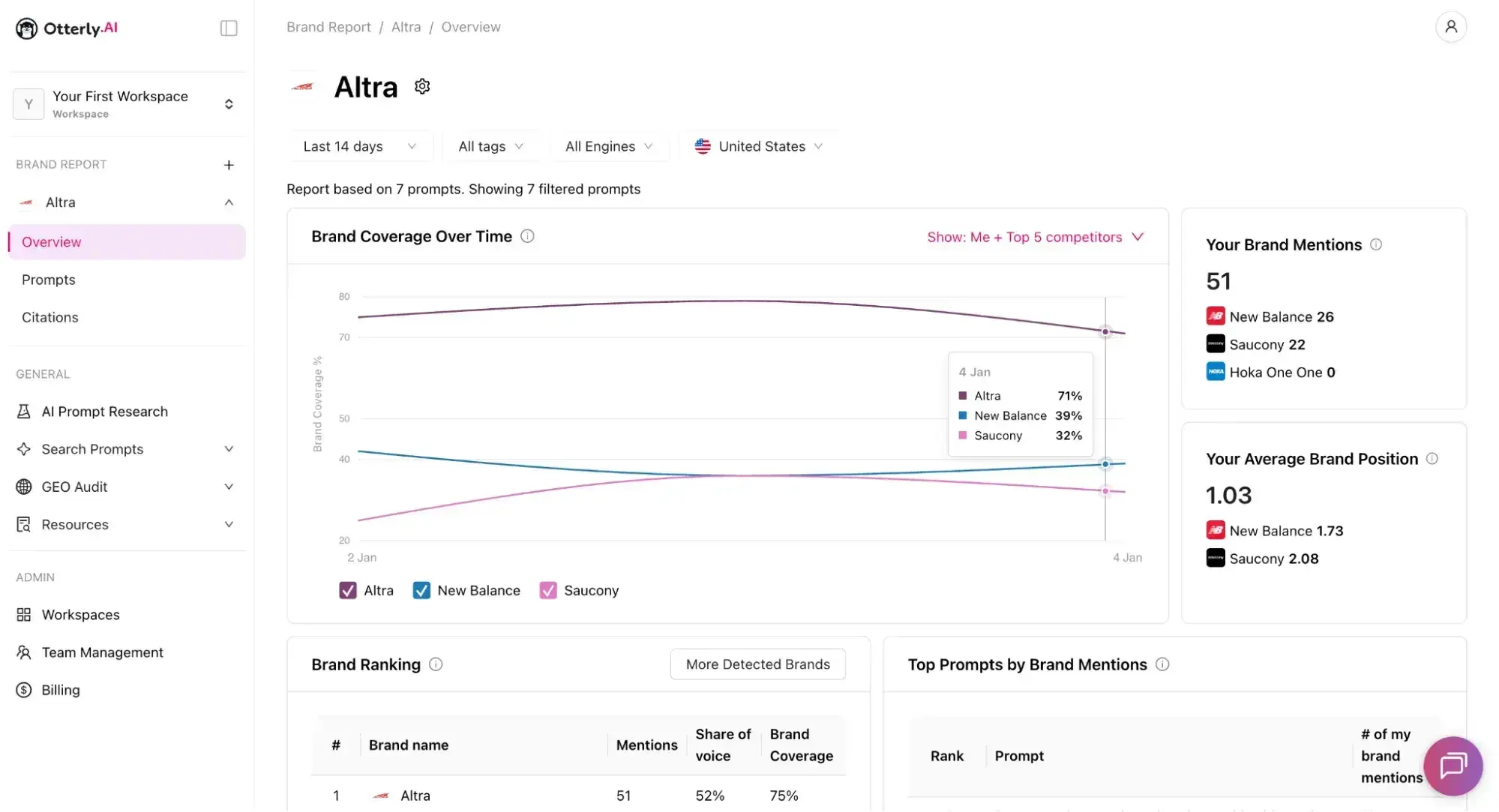
Source
Best for: Lean teams starting AEO tracking without enterprise complexity
Otterly covers six answer engines: ChatGPT, Perplexity, Google AI Overviews, and Copilot, with Google AI Mode and Gemini offered as paid add-ons. It has average brand position in AI answers, sentiment tracking, and an audit evaluating 25+ factors. Otterly pricing starts at $29/month for 15 prompts, scaling to $489/month for 400.
Frequently Asked Questions About AEO Rank Trackers
Do AEO rank trackers replace traditional SEO tools?
No. They measure different things. SEO tools track where your site’s blue link appears in the list on a search engine results page, as well as clicks, impressions, and the like. AEO trackers measure citations, mentions, and share of voice within AI-generated responses, though they can also measure where your brand appears in a list of citations in AI answers. Most teams will need both AEO and SEO tools for a complete picture of search visibility. For the SEO side, learning how to find SERP features opportunities can complement your AEO data.
How often should I refresh prompts and measurements?
I’d recommend reviewing prompt performance weekly and refreshing your prompt list monthly. Weekly check-ins help you spot sudden shifts, such as a competitor entering answers where they weren’t before, or a drop in your citation rate after a model update. Monthly prompt reviews ensure you’re still tracking the questions your buyers are actually asking, since those evolve as markets and products change.
Can I measure persona-level visibility with AEO trackers?
Some trackers support this through geo, language, and audience segmentation controls. The idea is that the same prompt can return different answers depending on the user’s location or profile context. If your tracker lets you run prompts with persona-level parameters, you can compare how visibility shifts across buyer segments or regional markets. This is especially useful for teams investing in local SEO, where AI answers may vary significantly by geography. Not every platform offers this, so it’s worth confirming during evaluation.
What’s the simplest way to start if I have limited budget?
Start with HubSpot’s free AEO Grader. It gives you a baseline AI visibility score without requiring a paid subscription, so you can see where your brand stands before committing to a full tracker.