/PRNewswire/ — At MWC Barcelona 2026, Huawei hosted a forum entitled“Accelerate Transportation Digital Intelligence”. Together with customers, partners and industry experts, Huawei explored new paths for intelligent transportation, shared its latest technological achievements and announced five innovative solutions, aimed at bringing mobility and logistics to an intelligent world.
David Shi, Vice President of ICT Marketing and Solution Sales, Huawei
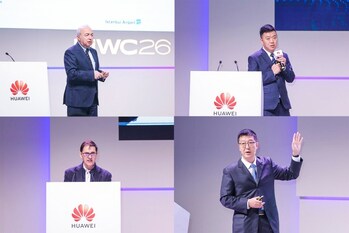
Guest speakers (from top left): PhD. Reha Cetin, Zaiming Ren, Carlos López Gutierrez, and Yang Rong
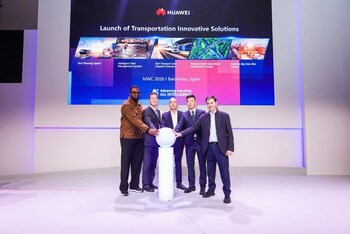
Huawei alongside its customers and partners announces five solutions
David Shi, Vice President of ICT Marketing and Solution Sales at Huawei, said that “Huawei is oriented towards openness, cooperation and sharing success. We will work with customers and partners to build a strong digital and intelligent foundation, connecting flows of passengers, cargo, business, business, revenue and information.” He further added that Huawei will integrate AI into railway, road, logistics, airport and port scenarios to improve safety and efficiency in the transportation and logistics sector, fostering greater collaboration with the tourism, energy and trade sectors for a better future.
Reha Çetin, CIO of Istanbul Grand Airport and CEO of IST System, highlighted that, as a fast-growing European hub, Istanbul Airport will continue to promote Airport 5.0 digital transformation and offer next-generation airport experiences, based on Huawei’s cutting-edge digital technologies and ICT expertise.
Zaiming Ren, deputy general manager of CRSC International (China Railway Signal & Communication Division), explained how FRMCS (Future Railway Mobile Communication System) improves train control efficiency, increases rail transportation capacity and reduces life cycle costs, helping advanced rail systems operate more efficiently and safely.
AI is set to become the core of intelligent transportation systems. Carlos López Gutiérrez, Director of SICE’s Transportation BU, said: “SICE and Huawei are working to use AI and edge computing platforms to explore and support various transportation scenarios, significantly improving infrastructure connectivity and the reliability of the transportation system.”
Ports play a crucial role in stabilizing economic cycles and ensuring industrial and supply chain continuity. Yang Rong, general engineer of Tianjin Port (Group) Co., Ltd., specified that Tianjin Port has always given priority to integrating ICTs such as 5G, AI, cloud computing and autonomous driving into its services. So far, they have digitally managed all elements of the port and implemented an intelligent horizontal transportation system, in order to shape the future of world-class smart ports.
Rachad Nassar, Global Business & Strategic Partners Director of Huawei’s Smart Transportation BU, announced that the company has created a comprehensive digital foundation for the global transportation industry. By implementing an integrated architecture of intelligent sensors, connectivity, digital platforms and applications, Huawei is working with ecosystem partners to launch five specialized solutions in four main scenarios. These innovations offer the following key benefits:
- Road transportation: Huawei introduced the Transportation Operations Coordination Center (TOCC) solution, based on ITS, to increase efficiency in various scenarios, such as integrated transportation monitoring, assistance during tourist travel and multimodal logistics. The project establishes a new model for the integrated management and control of urban transport.
- Rail transportation: Huawei has developed the Next-Gen Bearer Network for Operation and Dispatching solution for railways. Ensuring high reliability, wide bandwidth and low latency, the solution ensures safe and efficient operational communication services, promoting the railway sector’s transition towards intelligent digital.
- Customs: Huawei, in collaboration with its partners, has launched a solution to control risks related to big data. Leveraging Huawei’s big data platforms and partner data governance and services, the solution efficiently integrates multi-source heterogeneous data and responds to risks in seconds. It addresses traditional risk control challenges, such as limited size, incomplete coverage and heavy reliance on manual processes, enabling customs authorities to improve the accuracy of controls and the efficiency of customs clearance procedures.
- Ports: Huawei has developed the industry’s first integrated planning agent based on chain-of-thought (CoT) technology. The agent coordinates the entire port operational process, including berth planning, distribution and transportation, reducing operation planning times from hours to minutes. The intelligent solution for horizontal transport 2.0 supports efficient mixed traffic of manual container trucks and intelligent guided vehicles (IGVs). It enables large-scale planning of over 300 vehicles, reduces manual intervention rates to less than 0.1% and ensures precise alignment during parking with an operating position within ±5 cm, increasing the efficiency of goods handling.
During the forum, Huawei and Surge announced the successful commercial deployment of 1.4 GHz 5G fixed wireless network (FWA) for railway lines, the first in the world. This milestone represents a sea change in rail connectivity, providing next-generation communications networks along Indonesia’s railways and enabling inclusive network coverage nationwide.
Additionally, Huawei highlighted key innovations, made in collaboration with its global partners, in advancing the digital and intelligent transportation ecosystem. A great example is the Global Smart Port Showcase presented with Shandong Port Group. Through the integration of big data, large models and other cutting-edge technologies, the showcase showcases specific applications such as digital operations and intelligent planning, serving as a model for the modernization of the global port industry.
To date, Huawei serves more than 100 ports, more than 210 airports and airlines, more than 300 subway lines, more than 180,000 km of railways, spanning more than 200,000 km of road networks, ITS projects in more than 70 cities, and more than 200 logistics enterprises worldwide. Looking ahead, Huawei will continue to implement the “platform + ecosystem” strategy. The company specializes in the development of transportation hubs, networks, passenger and cargo flows, and low-altitude mobility systems to create a digital, intelligent foundation for transportation and logistics. Huawei is committed to “driving mobility and logistics towards an intelligent world” by enhancing intelligent transportation.
Photo – https://mma.prnewswire.com/media/2929040/1.jpg
Photo -https://mma.prnewswire.com/media/2929041/2.jpg
Photo -https://mma.prnewswire.com/media/2929042/3.jpg
