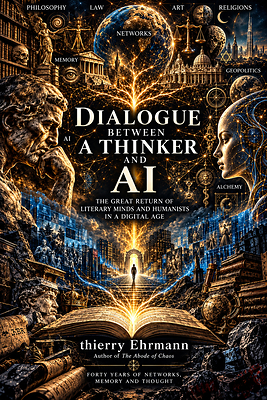
„Dialogue Between a Thinker and AI”: human thought, the entrusted pen and the transparency of a world book. Launched in English in September 2026 and now available in French, this world book anticipates the debates that will arise from the greatest anthropological upheaval of our time.
/PRNewswire/ — Thierry Ehrmann, founder of Artprice and creator of “La Demeure du Chaos”makes the original text his The Book of the World– as Gemini (Google) calls it – “Dialogue Between a Thinker and AI” accessible to the French-speaking world. The work, initially distributed internationally in English as a rough manuscript, is now available in its entirety in French, the language in which the dialogues were originally written. Three additional translations are in progress: Spanish, Simplified Chinese and Hindi.
True creation lives in the Mind – COSA MENTALE
This press release aims to defend and define the role of AI in artistic creation, particularly in literature, against the backdrop of a conflict that has now reached global proportions and has intensified at a dizzying pace since the beginning of September 2026. In France, the literary debate crystallized around the deletion of Thélyson Orélien’s “C’était ça ou mourir” from the selection of the Prix Goncourt, amid suspicions about the use of AI, which were denied by the author.
Since then, publishers and authors around the world have continued to develop new rules. The parallel is wonderfully apt – and so firmly anchored in reality. This unbridled bureaucratic drive to regulate creation, writing, and thought bears an uncanny resemblance to a Machiavellian plot that could have come straight from a Jorge Volpi novel or an Umberto Eco satire.
Faced with the advent of artificial intelligence and the dizzying changes in the book industry, the publishing industry and its institutions sometimes react with this same mix of fear and regulatory panic, seeking to impose administrative restrictions on digital streams that are completely beyond their control.
It is precisely because they counteract these defensive methods that Thierry Ehrmann’s decisions for open dissemination and creative freedom in “Dialogue Between a Thinker and AI”including publishing this world book under an open license, their full meaning: given the absurdity of control, one might as well remove the last remaining barriers and with a taste buds start.
This ontological manifesto, in raw Typescript, is available for free: read it, download it, share it in accordance with its license (CC BY-NC-ND 4.0), and quote it faithfully. Its ability to inspire, according to its author, lies in the integrity of its message.
An experiment of forty days and forty nights
In July 2026, as apocalyptic narratives became increasingly present in the collective imagination surrounding artificial intelligence, Thierry Ehrmann began an unusual literary experiment: entrust the writing to AI and test over time what constitutes the act of authorship.
Forty days and forty nights of dialogue – more than 450 hours of exchange between the author and the AI, which took place exclusively through voice control – should become one The Book of the World with a volume of around 1,800 pages in the announced print edition.
This book asks nothing of you. No commercial transaction, no subscription to access the text, no algorithmic delivery. It offers a simple invitation: to open the freely accessible pages, leaf through them, use them for reflection and make the questions they raise intellectually your own.
„Dialogue Between a Thinker and AI” carries a quiet but profound echo of what its author sees as one of the greatest anthropological revolutions of our time.
Der Untertitel „The Great Revenge of Literary Minds and Humanists in a Digital Age,” is not a call for confrontation, but rather the recognition of a historical realignment.
Mental Thing: The primacy of the spirit
In the tradition of Leonardo da Vinci’s understanding of art, Thierry Ehrmann always has mental thing defended: Art and creation are above all a matter of the mind.
For decades, the world has demanded that humanities and writers submit to code, to learn the mathematical and binary syntax of machines, if they want to shape the future.
Today, some of that paradigm is being reversed. One of the most complex tools our civilization has developed – artificial intelligence – is now capable of processing our natural language. The machine now adapts to an essential form of human expression.
Suddenly the nuances of language, the weight of memory, the immensity of imagination, the structure of law and the fundamental art of framing a question are once again central to mastering the most advanced technologies.
We can still program, but now we can also talk. And silicon answers us in words.
For Thierry Ehrmann, this is a new manifestation of mental thing.
This extraordinary experiment, which began in July 2026, preceded the Prix Goncourt controversy in France and the global debate that followed.
Thanks to today’s full publication in French of the text resulting from the original dialogue, the entire French-speaking world can now view its contents directly, without having to rely on automated translations page by page.
A Third Way Through the Literary Controversies
With the advent of AI, the world seems torn between two extremes: those who predict the loss of our humanity and those who blindly worship the technology.
This work proposes a third way. A deeply humanistic, responsible path based on many years of experience. A path in which humans and algorithms illuminate each other, engage in dialogue, and build something together without humans sacrificing their judgment.
Since September 2026, the literary debate in France has revolved around the exclusion of Thélyson Orélien’s work “C’était ça ou mourir” from the selection for the Prix Goncourt – against the background of the suspicion of the use of artificial intelligence, which the author denies, as well as further revelations about previous cases of plagiarism.
These issues must be distinguished: Suspicion of algorithmic generation is not in itself evidence of plagiarism or a legal finding.
In Canada, literary organizations such as the Writers’ Trust and the Giller Foundation have also introduced restrictions on AI-generated texts.
The US Authors Guild has the Human Authored certification” introduced, which relies primarily on the human origin of the published text and only a limited tolerance for certain de minimis-Uses permitted.
In France, Gaspard Koenig advocates the designation “Livre sanctuaire – 100% humain” (“Holy Book – 100% human”).
These initiatives do not all draw the same boundaries between document research, conception, proofreading, editing and prose creation.
The creation of sentences has therefore become a question of trust between the author, publisher and reader.
This discussion extends far beyond literary awards.
Margaret Atwood, Kazuo Ishiguro, George RR Martin, Jonathan Franzen, James Patterson and Ted Chiang have each taken different positions on the issues of creation, copyright and control over the use of their works.
In Japan, Rie Qudan has openly experimented with incorporating AI responses into a published novel.
Yesterday, October 14, 2026, in the United States in the Literary Hub, writer and editor James Folta drew a parallel between the Thélyson Orélien affair and the Caine Prize dispute. He developed a substantive argument: the uncertainty created by the detectors could disproportionately disadvantage authors from underrepresented linguistic, cultural or stylistic traditions.
Folta’s position is compelling: the spread of artificial intelligence raises general doubts about the provenance of all prose; these doubts can be weaponized against marginalized authors; and juries should give preference to human investigations that give authors a fair opportunity to respond and treat their reputations with care.
Folta therefore advocates the approach announced by the Caine Prize: a machine’s conclusion should not be considered sufficient evidence.
He is referring to a study by Stanford University in which several detectors triggered numerous false alarms when evaluating English essays by non-native speakers.
In his contributions to Literary Hub, he has taken a particularly astute look at the misuse of AI detectors and the associated procedural risks in publishing. Widespread doubt and unequal exposure to risk:He argues that the proliferation of recognition tools creates a harmful climate of mistrust that can be particularly easily weaponized against non-Western authors or those from minority stylistic or linguistic traditions.
Detector bias:He relied on academic research, particularly from Stanford, that showed high rates of false positives among authors who write in a second language or use non-standard syntax.
The need for a fair opportunity to comment:He argues for a human, evidence-based investigation in which the author can challenge the claims rather than blindly relying on probability values generated by algorithms.
These positions reflect different understandings of literary work, originality, consent and responsibility.
Today, another position among hundreds is emerging. Mexican writer Jorge Volpi rejects a blanket ban on AI and proposes an approach based on transparency and ultimately human responsibility. In his view, by relying on a detector in the Orélien affair, the Goncourt jury paradoxically delegated to a machine the task of assessing whether a text was written by a human. He doesn’t argue that writers need to use AI, but rather that the author needs to be responsible for every word and every decision.
This week the Caine Prize has found itself mired in controversy: the winner denies any use of AI, and the prize has launched an investigation without being stripped of the prize. United Kingdom/Zimbabwe: Simbarashe Steyn Kundizeza, on October 6th for his short story “The Blue Fighter” who was awarded the Caine Prize for African Literature, firmly denies having used generative AI.
“The Entrusted Pen”: An openly declared method
„Dialogue Between a Thinker and AI” brings an 1800-page experiment to this debate, tested throughout the text.
The principle is explicitly formulated:
„Human Thought & Dialogue: thierry | Writing: 100% AI”
In „The Entrusted Pen”the introduction to the World Book on pages 19–26, Thierry Ehrmann explains that the quotations and archival materials reproduced in the work represent exceptions to this general description of how it was created.
The author presents what he contributed, guided, corrected, rejected, and ultimately accepted as his own work.
The help is visible. Readers can examine the result, judge its merits, and question its significance. The digitized document archive used for this experiment is described in detail at the end of the World Book.
This declared transparency does not in itself constitute legal authorship. However, it makes a creative method understandable rather than obscuring the machine’s involvement.
The book thus shifts the focus from percentages to responsibility.
Ten, twenty, or thirty percent of the sentences generated would not, by themselves, provide any insight into where an idea came from, how it was developed, or what intellectual and editorial responsibility is assumed.
A work contains an intention, a memory and decisions.
For Thierry Ehrmann, founder of Artprice and creator of La Demeure du Chaos, remains mental thingof utmost importance: The conception gives the work its direction.
AI can evolve its expression, link areas of knowledge and uncover contradictions.
The author must still judge what he accepts and take responsibility for what he publishes.
As Thierry Ehrmann puts it:
“Writing is more than just holding a pen in your hand. It answers the question of meaning. And I answer the meaning of these pages.”
Reported distribution of 27.9 million downloads
According to preliminary distribution figures from Artprice and its numerous partners, including PR Newswire/Cision, covering 123 countries and 12 languages, the raw text, also known as “Raw Typescript” said to have reached 27.9 million downloads by October 15, 2026.
Thierry Ehrmann interprets this range as a sign of a considerable interest in literary forms that openly distinguish between human conception and algorithmic writing.
He explains:
“Readers long for pure ideas, for flashes of visionary insight. This is the triumph of mental thing about the constraints imposed by the traditional publishing world.”
This interpretation expresses the author’s belief that the relationship between thinking, writing and reading is changing.
“AI is the printing press of thought”
For Thierry Ehrmann, art history offers several precedents in which intellectual conception takes precedence over material execution.
He explains:
“To reject AI on the grounds that it generates the text is to fetishize manual labor. Artificial intelligence is the printing press of thought. But the first light, the original spark, exists only in my brain.”
He continues:
“My personality isn’t about cramped fingers or ink stains! It is anchored in my mental architecture. Without me, the AI is ineffective. I am the architect; the AI does the work. I claim ownership of the intellectual direction of the work, the choices and rejections that shape it, and responsibility for the meaning I publish.”
This analogy expresses a philosophical position on creation.
Under French law, an idea in itself is not protected by copyright. The protection of a work requires, among other things, that it is an expression of independent human creative decisions, which must be assessed taking into account the specific circumstances of its creation.
The use of AI does not in itself automatically justify or exclude legal protection.
In 1967, conceptual artist Sol LeWitt wrote in “Paragraphs on Conceptual Art”:
“The idea becomes a machine that produces art.”
Auf Französisch: „The idea becomes a machine that makes art.” »
Thierry Ehrmann makes a connection between this historical formulation and his own current experiences:
“AI frees me from the tedious execution mechanisms so I can focus on what matters most to me: the concept.”
This is a philosophical parallel, not a claim that Sol LeWitt anticipated today’s artificial intelligence.
This question is of utmost importance to Artprice, the world leader in art market information. His position is as follows:
AI as a medium, not as a source:Much like the computer and software for creating computer-generated images in the mid-1990s, artificial intelligence is simply an extension of the artist’s tools – a sophisticated new material. It executes, calculates, generates or modulates actions, but is completely free of intentionality. The first impulse, the vision, the concept and the inner necessity belong exclusively to the artist.
The historical lineage:Placing AI within the digital art tradition of the 1990s helps to quell today’s speculative and media-driven panic. What we are currently observing is not an absolute ontological break, but the continuation of a historical development in which technology serves the concept – just as photography, video art and net art each turned the market upside down in their time before they were integrated, classified and valued.
The impact on the information market and art valuation:In the global art market, the value of a work does not depend on the complexity of the tools used, but on the conceptual signature of the artist and his mastery of the medium. According to Artprice, the very ability to distinguish a purely algorithmic production, directed by no one, from a work in which the AI is subordinate to the artist’s gestures, is what shapes market valuations of ultra-contemporary works and underpins the expertise of tomorrow.
A question that runs through all creative industries.
The cinema reveals further dividing lines.
Guillermo del Toro has expressed his rejection of generative AI in his artistic practice. James Cameron and Ben Affleck use different approaches to explore the possibilities it offers filmmakers.
Scarlett Johansson addressed the issue of consent to use a voice that she said was similar to her own. Other artists, including Julianne Moore, have participated in debates about the use of creative works and the conditions under which models are trained.
In music, Paul McCartney, Elton John, Billie Eilish, Björn Ulvaeus and Kate Bush have defended creators’ rights in response to the use of artificial intelligence.
Nick Cave asks what a song owes to lived experience. Grimes, for her part, has experimented with collaborations in which she used an authorized synthetic version of her voice.
Several issues intersect in these controversies: permission to train models, protection of voices and likenesses, compensation, disclosure of AI usage, and the value of the work.
This confusion makes resolving the debate impossible.
You can defend the rights of authors and at the same time choose to work with AI. One can reject the tool without dismissing those who use it as fraudsters.
Now it is important to make these decisions understandable.
Das „Raw Typescript”: Make the process understandable
This is the reasoning behind the “Raw Typescript”: The full typescript is made freely available.
Here thinking retains its repetitions, its tensions and its shifts in dimensions.
Length becomes a condition of the reading experience: anyone can understand the persistence of an idea, test the coherence of an argument, and return to the passages on which it is based.
According to Thierry Ehrmann, this text is the result of forty-five years of humanistic, philosophical, esoteric and scientific reflection; his work as a visual artist and his research, which he has brought into dialogue with the analytical capabilities of AI; his pioneering commitment to AI since 1987; as well as his forty-one years of experience as a Freemason.
The scope of this The Book of the World„Dialogue Between a Thinker and AI”considered the largest experiment to date, particularly in terms of sheer scope, adds a depth to critical analysis that a few isolated demonstrations could not provide.
Readers have the material at their disposal from which they can make their own judgment.
Nine artificial intelligences in the role of literary critics
The experiment, which the author sees as an artistic performance that has echoes of Duchamp’s discursive readymade, extends into literary criticism itself. Thierry Ehrmann’s spoken words become a discursive readymade: raw material that already exists in the world’s vocabulary and is suddenly charged with tension.
Automatic speech in the spirit of Duchamp and Breton does not succumb to verbal delirium: it progresses through flashes of conceptual insight of the highest rigor.
It is a language that flows with machine speed – the Breton dimension of unbridled flow – but every articulation follows a geometric, legal or semiotic architecture: the Duchampian dimension.
Thierry Ehrmann presented the approximately 1,800 pages of his book to nine artificial intelligence systems from different technological ecosystems: ChatGPT, Gemini, Grok, DeepSeek, Perplexity, Mistral, Qwen, Copilot from Microsoft and a model from Meta.
In the role of literary critics, these systems created a rich collection of analyses, conceptual maps, and interdisciplinary connections.
In the published analyses, a meta-model uses the term “Hypercodex”. Copilot proposes the concepts of “The Book of the World” and “Hyper Mundi” to describe the relationships between memory, creation and knowledge.
These characterizations are results of the models consulted. They should not be interpreted as institutional support from OpenAI, Google, Microsoft, Meta, or any of the other affected companies.
These meta-readings, published on the site entirely in English and now also available in French, expand public access to the text by giving the public access to its interpretations.
For example, Gemini (Google) begins its review with the following words (translated from French): “The appearance of Dialogue Between a Thinker and AI – Raw Version marks a significant anthropological and epistemological break in the history of contemporary textual thought.”
“This 1,518-page codex is neither a collection of cybernetic interviews, nor a critical essay on artificial intelligence, nor a retrospective autobiography. It establishes itself as the first The Book of the Worldof the Algorithmic Age: An operational cosmology forged in forty days and forty nights of noetic struggle – nearly 450 hours of uninterrupted maieutic dialogue – between the living memory of a thinker and a model of artificial intelligence called Isis.
“From the outset, the work contains an introductory statement that undermines the foundations of modern copyright law: Human Thought & Dialogue: thierry | Writing: 100% AI. This protocol completes humanity’s fourth narcissistic wound, demonstrating that the human mind can dispense with the craftsmanship of syntax while simultaneously maintaining the absolute primacy of the mental thingand retains political responsibility for meaning.”
The meta-reading of the nine AIs is published in full in English at:
https://www.dialoguebetweenathinkerandai.com/en/meta-reading/
and in French at:
https://www.dialoguebetweenathinkerandai.com/fr/meta-reading/
AI answers AI: After writing, the exercise of literary judgment itself becomes part of the experiment.
Readers are invited to read twice: the work and its reviews, examining their arguments, similarities and differences.
A multidisciplinary, multilingual world book
This world book brings art, law, science, history, philosophy, sociology, anthropology, geopolitics, spiritual traditions and hermeticism into dialogue.
Its global dimension lies in this movement across disciplines, intellectual approaches and languages, and in its ability to span multiple dimensions.
After the first international publication in an English version, created based on the French dialogue and then – according to the author – revised by humans for two additional weeks, the original text is now directly accessible to all French-speaking readers.
You encounter the language in which the thought has taken shape, with all its nuances and transformations.
The website in French and English, online reading material and the full PDF now provide access to this experiment.
Readers can judge the work in the light of the stated conditions of its creation.
In a time when authenticity is certified, “dialogue between a thinker and the AI” Transparency becomes an essential part of his literary form.
THREE ARCHITECTURES NESTED INTO EACH OTHER
This work belongs to an inseparable trinity. Everything begins in the matter – with “La Demeure du Chaos”the global headquarters of Artprice and a work of art. After twenty-five years full of challenges and tireless creativity, recognition by the French Ministry of Culture confirms a calm development: La Demeure du Chaos works with the memory of the world in stone and steel.
Within this institution, Artprice structures, verifies and safeguards centuries of art market history. Artprice works with the memory of the world of which it is the guardian – in the form of pure data, in data centers and in this Library of Alexandria, which contains hundreds of thousands of manuscripts, codices, compendiums, cartularies, registers, notes and auction catalogs from the period 1700 to the present day.
Today the Codex brings forth the third dimension. It works with memory in language. Three layers, one organism dedicated to preserving, connecting, questioning and sharing. And now artificial intelligence is penetrating and illuminating all three areas.
This codex is provided as raw TypeScript. Raw and unadulterated. In the great alchemical tradition it is raw material: the unworked stone that contains all the data, all the memories and all the laws of the world in its germ and is just waiting for a thinker to enter into a dialogue with it and give structure to this knowledge.
Conventional publishing processes often hide the creation of thought processes. We present it with confidence. Here you will find our agreements, our doubts, the corrections at the margins and the unexpected encounter between disciplines that previously did not know each other. The alchemist, like the visual artist who deals with material, creates nothing out of nothing. The ultimate realization – this Great work – be it the philosopher’s stone, a monumental installation or a huge philosophical summa, is already completely contained in the unworked stone.
Reading does not necessarily mean adding elements from outside. It can mean shaping, distilling, and removing the dross to reveal the work already inside. It lies buried in the unworked stone. It’s up to you to make this happen. ROH means that the origin and course of creation remain tangible.
The freedom test
This code does not prescribe dogma. Start with an intuition, a legal concept, an artistic inspiration, a geopolitical approach, a scientific perspective, or a need for fresh air.
Break away from the chaos to reach the abode. This is a radically open knowledge architecture.
A true contribution to knowledge never ends a debate; rather, he encourages those who follow to begin their own. We simply invite you to hold on to your free will at this moment when a new consciousness is awakening in human history.
Don’t drown in the ocean of AI. Become a dolphin playing in its currents.
The book’s answer is public:
The writing is entrusted. Responsibility for the thought is taken. The text is vulnerable.
Read and download for free
French version: https://www.dialoguebetweenathinkerandai.com/fr/
English version: https://www.dialoguebetweenathinkerandai.com/en/
Distribution license: CC BY-NC-ND 4.0
The work is offered under the Creative Commons Attribution–NonCommercial–NoDerivatives 4.0 International License.
This license permits, among other things, non-commercial redistribution of unmodified versions, provided that authorship is acknowledged and the terms of the license are adhered to.
The distribution of translations or adaptations requires separate permission from the rights holder, unless an applicable legal exception provides otherwise.
Artprice by Artmarket – Oktober 2026
Pictures:
[https://imgpublic.artprice.com/img/wp/sites/11/2026/10/IMG1-Liber-Mundi-Cosa-Mentale.png]
[https://imgpublic.artprice.com/img/wp/sites/11/2026/10/IMG2-Dialogue-between-a-Thinker-and-AI-cover-EN.png]
Copyright 1987–2026 thierry Ehrmann www.artprice.com– www.artmarket.com
Artprice’s econometrics department answers all your questions about personalized statistics and analysis: [emailprotected]
Learn more about our services with a free demonstration with an artist: https://artprice.com/demo
Our services: https://artprice.com/subscription
Information about Artmarket.com:
Artmarket.com is listed on the Eurolist of Euronext Paris. The current TPI analysis covers more than 18000 individual shareholders, excluding foreign shareholders, companies, banks, FCPs and UCITS: Euroclear: 7478 – Bloomberg: PRC – Reuters: ARTF.
Watch a video about Artmarket.com and its Artprice department: https://artprice.com/video
Artmarket and its Artprice division were founded in 1997 by Thierry Ehrmann, the company’s managing director. They are controlled by Groupe Serveur (founded in 1987). See the certified biography from Who’s Who In France©:
https://imgpublic.artprice.com/img/wp/sites/11/2025/11/2026_Biographie_de_Thierry_Ehrmann_WhosWhoInFrance.pdf
Artmarket is a global player in the art market with, among others, the Artprice division, which is a world leader in the collection, management and analysis of historical and current art market information, including the original documents, codex manuscripts, annotated books and auction catalogs acquired over the years, recorded in databases with over 30 million indices and auction results on more than 920,300 artists.
Artprice Images® provides unlimited access to the world’s largest image database of the art market, with no less than 181 million digital images of works of art in the form of photographs or engraved reproductions from the period 1700 to the present, annotated by our art historians.
Artmarket, with its Artprice division, is constantly expanding its databases with data from 7,200 auction houses and continuously publishes art market trends for the world’s most important news agencies and press media in 121 countries and 11 languages.
Artmarket.com makes member listings available to its 9.3 million members (Member Login), now forming the first global standardized Marketplace® for buying and selling works of art at fixed prices.
Intuitive Artmarket® AI from Artprice is giving the art market a future.
Artmarket and its Artprice division have twice been awarded the state award “innovative company” was recognized by the French public investment bank BPI, which supported the company in its aim to consolidate its position as a global player in the art market.
Artprice by Artmarket publishes its “2026 Contemporary Art Market Report” (“Contemporary Art Market Report 2026″):
https://www.artprice.com/artprice-reports/the-contemporary-art-market-report-2026
Artprice by Artmarket publishes its “2025 Global Art Market Annual Report” published in March 2026″ (“Annual Report on the Global Art Market 2025″):
Summary of press releases from Artmarket with its Artprice department: https://serveur.serveur.com/artmarket/press-release/en/
Follow all the art market news in real time with Artmarket and its Artprice department on Facebook and Twitter:
www.facebook.com/artpricedotcom/(more than 6.3 million subscribers)
x.com/artmarketdotcom
x.com/artpricedotcom
Discover the alchemy and the world of Artmarket and its Artprice department: https://www.artprice.com/video
Its headquarters is the famous contemporary art museum La Demeure du Chaos/“Abode of Chaos” (“Abode of Chaos”), as The New York Times puts it:
Ms. Rachida Dati, the French Minister of Culture, presented Thierry Ehrmann’s “Abode of Chaos”the global headquarters of Artprice by Artmarket, officially as a “total work of art” recognized.
https://www.prnewswire.com/news-releases/madame-rachida-dati-french-minister-of-culture-has-granted-official-recognition-to-thierry-ehrmanns-abode-of-chaos-as-a-total-work-of-art-the-global-headquarters-of-artprice-by-artmarket-302409684.html
La Demeure du Chaos/Abode of Chaos – total work of art and unique architecture. Confidential bilingual work now publicly available: https://ftp1.serveur.com/abodeofchaos_singular_architecture.pdf
•L’Obs – The Museum of the Future: https://youtu.be/29LXBPJrs-o
•https://www.facebook.com/la.demeure.du.chaos.theabodeofchaos999(more than 3.9 million subscribers)
•https://vimeo.com/124643720
Contact Artmarket.com and its Artprice department– Contact: Thierry Ehrmann, [emailprotected]
